
Yes, Las Vegas builders are widely offering stacked incentives in 2026, but a headline credit is not automatically a bargain. Rate buydowns, closing-cost help, and design-center allowances can genuinely lower your cost, though many are tied to the builder's preferred lender, whose rate and fees may erase the savings. Before signing anything, request written terms and run the total-cost math with your own agent or lender.
TL;DR:
- Builder incentives often require financed through the builder’s preferred lender, whose high rates can negate the perceived savings over a long loan term.
- To truly benefit, buyers should compare the builder-lender's rate and fees with outside options before committing to an incentive package.
- Incentives like buydowns and credits are most advantageous for short-term holds of less than two years, while long-term owners benefit more from permanent discounts.
- Always request written confirmation of incentive terms and verify that credits are itemized as price reductions rather than lender-specific subsidies for lasting value.
- An experienced agent can help renegotiate incentive terms, compare lender offers, and ensure credits translate into long-lasting savings.
Table of Contents
- What Are Builder Incentives in Las Vegas Right Now?
- How Do You Compare Builder Incentive Offers?
- How Do You Negotiate and Document Builder Incentives?
- Which Incentive Fits Your Timeline and Goals?
- Do Builder Incentives Carry Tax Implications in Nevada?
- Custom Homes vs Production Communities: Do Incentives Differ?
- An Agent's View: Capturing Real Incentive Value
- How Yelena Horton Helps You Capture the Best Incentive
- Sources
- FAQ
What Are Builder Incentives in Las Vegas Right Now?
A builder incentive is any concession a homebuilder offers to move a sale forward, whether that is cash toward closing, a lower interest rate, or free upgrades. Across the valley, four types dominate the conversation this year.
- Temporary rate buydowns (2-1 buydowns): the builder or lender subsidizes your rate so it starts two points below the note rate in year one, one point below in year two, then settles at the full rate in year three.
- Permanent buydowns: discount points paid upfront to lower your rate for the life of the loan, which matters more if you plan to stay put for a decade or longer.
- Closing-cost credits: commonly $10,000 to $30,000 toward fees, prepaids, or rate buydowns on new Las Vegas construction, according to community-level incentive breakdowns.
- Design-center allowances: dollars earmarked for flooring, countertops, and fixtures rather than cash back at closing.
Inventory homes, meaning units that are already built or nearly finished, tend to carry deeper concession stacks because the builder wants finished product off the books. To-be-built homes, by contrast, usually offer smaller upfront credits but more flexibility on floor plan and finish selections. Northwest Las Vegas has become a hotspot for aggressive offers as standing inventory has climbed, a pattern documented in 2026 builder incentive reporting. Stacking a buydown with a closing credit and an upgrade allowance can function like a meaningful price reduction, but only if the lender terms behind it hold up under scrutiny.
How Do You Compare Builder Incentive Offers?
A credit that looks generous on the sales sheet can still cost you money over time. The only way to know is to run three numbers side by side rather than looking at the incentive in isolation.
- Upfront cash to close. What do you actually pay on closing day after every credit is applied?
- Monthly payment during the buydown window. A 2-1 buydown lowers your payment for two years, then the payment jumps to the full note rate. Confirm you can absorb that jump.
- Long-term interest cost. Compare the builder-lender's rate and fees against at least one outside quote, projected over your expected hold period.
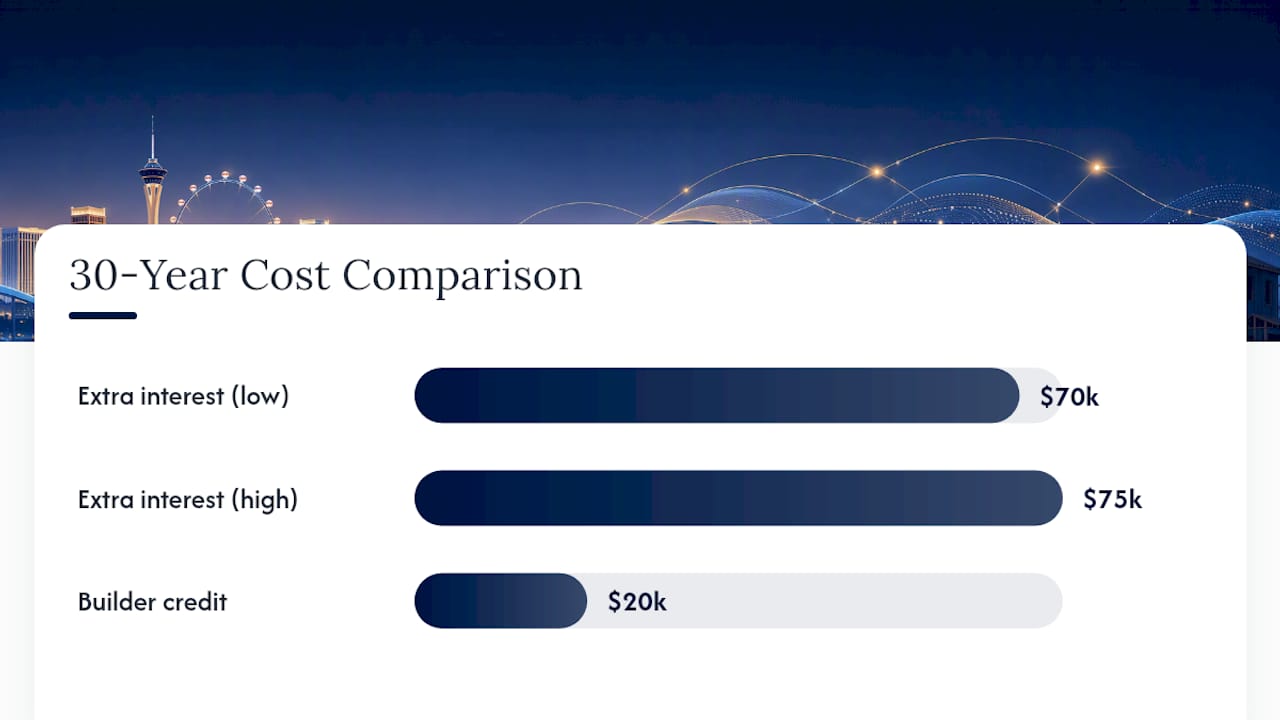
Local closing-cost analyses have found that builder credits frequently require using the builder's affiliated lender, and that lender's rate can run high enough to outweigh the credit's value over a 30-year term, according to Las Vegas builder financing research.
Over 30 years, that half-point difference can cost roughly $70,000 to $75,000 in additional interest, depending on amortization, dwarfing the $20,000 credit. The break-even only favors the builder's rate if you refinance well before the interest differential catches up.
Before you compare anything, collect four numbers: the builder-lender's rate and fees, one outside lender quote, the total incentive value, and your realistic hold period.
How Do You Negotiate and Document Builder Incentives?
Bring your buyer agent with you on the first visit to any sales office, and make sure that agent registers you before you tour a model home. The sales representative behind the desk works for the builder, not for you, and unregistered visits can forfeit your ability to use agent-assisted negotiation later.
Once you are in a conversation with the builder, ask directly:
- Is this incentive contingent on using your in-house or preferred lender?
- Is the rate buydown temporary or permanent, and what does the payment look like after the buydown expires?
- Does accepting this credit change the home's contract price, and how does that affect appraisal?
- What is the deadline to lock in this offer, and does it change if I go with an outside lender?
- Can you put every term of this offer in writing before I sign a purchase agreement?
Watch for red flags: unusually high lender fees buried in the loan estimate, vague or shifting deadlines, and incentives that require waiving standard buyer protections like inspection contingencies. On inventory homes, you often have more room to negotiate a lower lot premium or redirect a design-center allowance toward closing costs instead.
Pro Tip: Ask the builder to itemize the incentive as a credit against price rather than a lender-specific subsidy. A price-based credit typically survives a lender switch, while a lender-specific subsidy usually disappears if you finance elsewhere.
Which Incentive Fits Your Timeline and Goals?
The right incentive depends less on what sounds generous and more on how long you plan to keep the loan.
- Short hold, 12 to 24 months: temporary buydowns and closing-cost credits usually make sense, since you will refinance or sell before the rate resets and the long-term interest math matters less.
- Long-term hold, 7-plus years: permanent buydowns or a straightforward price reduction tend to outperform, because the compounding interest savings over decades outweighs a one-time credit.
- Investor buyers: weigh design-center credits against cash incentives by estimating the resale or rental return on the specific upgrades offered. A furniture and staging cost guide can help investors price out whether builder-provided finish upgrades actually move the needle on rent or resale versus taking the cash and furnishing to spec later.
- When to insist on a lender match: if your outside quote beats the builder-lender's rate by a meaningful margin, ask the builder to match it or redirect the incentive dollar-for-dollar into a price reduction instead.
Walk away from any offer where the builder will not put the lender comparison or the incentive terms in writing.
Do Builder Incentives Carry Tax Implications in Nevada?
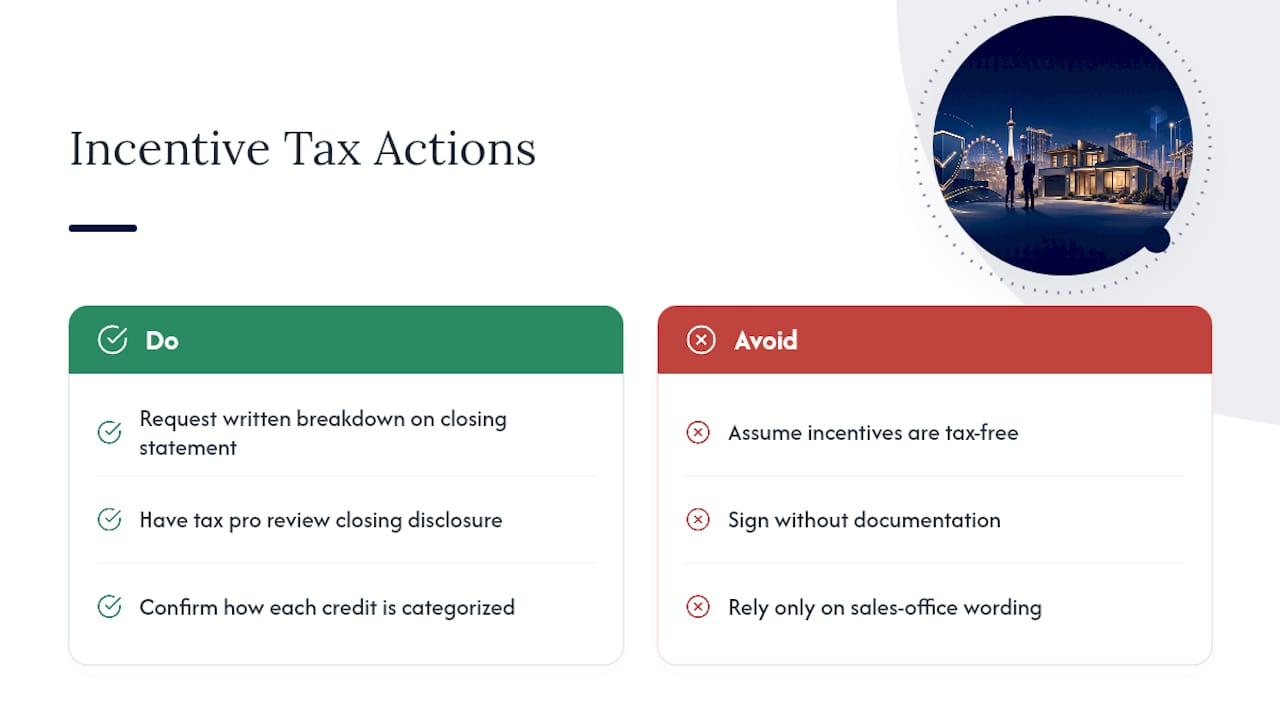
Nevada has no state income tax, which simplifies part of this picture for buyers weighing incentives against take-home savings. Federal tax treatment is where builder incentives get more nuanced. A closing-cost credit generally reduces your basis or your deductible closing expenses rather than counting as taxable income, while discount points paid to buy down your rate can sometimes be deducted in the year paid or amortized over the loan term, depending on how the IRS treats your specific transaction.
Design-center allowances typically get folded into the home's purchase price rather than treated as a separate taxable benefit, which matters for your cost basis if you sell later. Because these rules hinge on how the builder structures the incentive on paper, not just how it is marketed at the sales office, a written breakdown of exactly how each credit is categorized on your closing statement is worth requesting before you sign. A qualified tax professional should review your specific closing disclosure, since the categorization can shift the numbers on your return.
Custom Homes vs Production Communities: Do Incentives Differ?
Production builders in master-planned Las Vegas communities run standardized incentive menus because they are managing dozens or hundreds of homes at once, and moving inventory on a schedule matters to their bottom line. That standardization is exactly why 2-1 buydowns, fixed-dollar closing credits, and design-center allowances show up so consistently across northwest Las Vegas developments.
Custom home builders operate on a different model entirely. With a custom build, there is no standing inventory to clear and no sales-office menu of stackable credits, so incentives tend to be negotiated case by case rather than offered upfront. A custom builder is more likely to flex on allowances for structural upgrades, site work, or specification changes than to hand over a cash credit at closing. If you are comparing a production community against a custom lot, do not expect an apples-to-apples incentive conversation. The leverage in a custom build comes from negotiating the contract itself, not from chasing a published promotion.
An Agent's View: Capturing Real Incentive Value
Too many buyers walk into a model home, get charmed by a friendly sales representative, and never think to ask who that person actually works for. It is the builder, every time. Registering with your own buyer's agent on your first visit is not paperwork for its own sake. It is what preserves your ability to negotiate incentive stacking, confirm inventory status honestly, and push back when a lender's rate does not match the value of its credit.
An experienced agent has spent a career reading Las Vegas new-construction contracts line by line, with an eye for where a builder's "generous" offer quietly shifts cost onto the buyer. Their team pulls current community-specific incentive snapshots, coordinates lender comparisons, and negotiates reallocation of credits into permanent savings rather than short-term payment relief that expires. For out-of-state buyers, a relocation concierge service can add another layer of protection during a complex process.
— Yelena
How Yelena Horton Helps You Capture the Best Incentive
This brokerage exists for this kind of negotiation, where the difference between a good deal and a costly mistake sits buried in loan disclosures most buyers never read closely. Their buyer representation pairs directly with new construction guidance and financing insight, providing a second set of eyes on every incentive a builder offers before signing.

When you work with Yelena, you get a current incentive snapshot for the specific community you are considering, coordinated lender comparisons that put the builder's preferred rate side by side with outside quotes, and a written negotiation proposal built around your actual hold period rather than the sales office's script. Her expert negotiation services extend to reallocating design-center credits and closing-cost help into terms that actually serve your long-term budget, not just the deal that gets you to the signing table fastest. Out-of-state buyers relocating to Las Vegas can also lean on her relocation concierge for everything from timing a move around a buydown deadline to settling into the right neighborhood once escrow closes. If you are weighing a builder incentive anywhere in the valley, start the conversation with Yelena at Yhluxrealestate before you commit to a lender you have not compared.
Sources
- New Home Builder Incentives in Las Vegas: How They Work and What to Ask
- Las Vegas Builder Incentives Ramp Up in 2026 | Ryan Rose
- Builder Closing Cost Credits Las Vegas 2026
FAQ
What Are Builder Incentives?
Builder incentives are concessions a homebuilder offers to close a sale faster, including rate buydowns, closing-cost credits, and design-center allowances. In Las Vegas, these commonly range from $10,000 to $30,000 in combined value, per regional incentive coverage.
Are Builder Rebates in Las Vegas Negotiable?
Yes, especially on inventory homes the builder wants to move quickly. Bringing a buyer's agent to negotiate lot premiums, upgrade credits, and closing timelines typically captures more value than accepting the first offer at the sales office.
Do I Have to Use the Builder's Lender to Get the Incentive?
Often, yes. Many closing-cost credits and buydowns in Las Vegas require financing through the builder's preferred lender, and that lender's rate can offset the credit's value over a 30-year loan, according to local closing-cost analysis.
When Are Builder Incentives in Las Vegas the Most Generous?
Incentives tend to deepen near quarter-end and year-end sales pushes, as well as during builder promotional weekends, based on 2026 market reporting. Standing inventory in areas like northwest Las Vegas also drives more aggressive offers.
How Can Yhluxrealestate Help Me Evaluate a Builder Incentive?
Yelena Horton's team compares the builder's lender terms against outside quotes, verifies inventory status, and negotiates written incentive terms on your behalf. Reach out through Yhluxrealestate before signing a purchase agreement on new construction.