
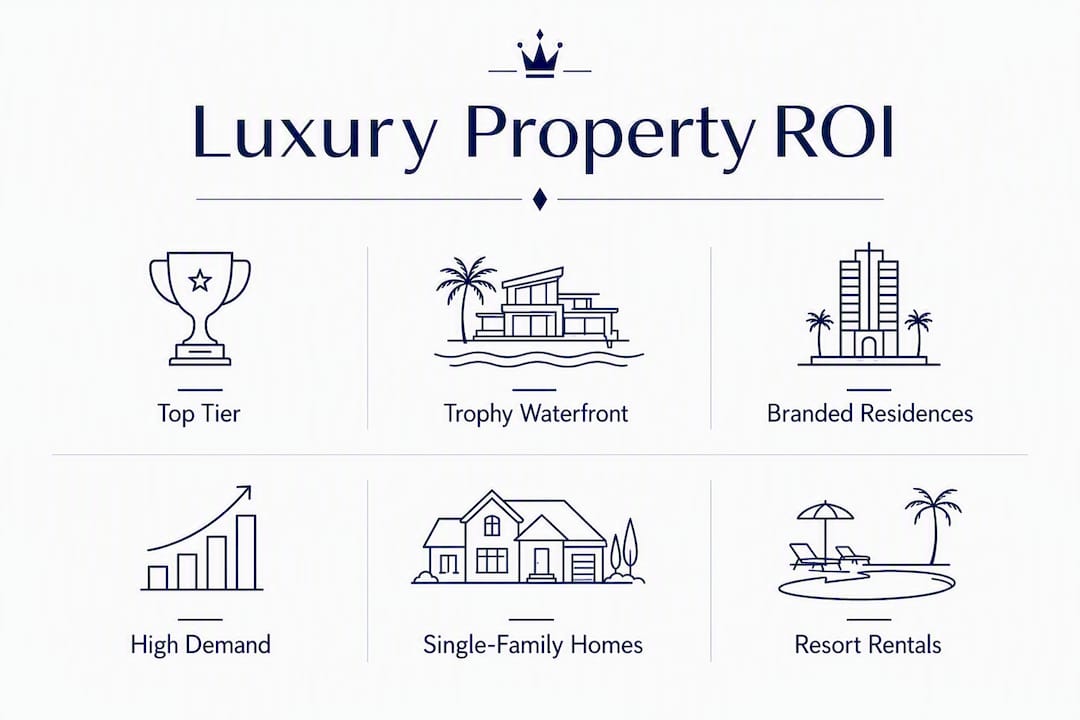
For affluent U.S. investors, the strongest long-term total returns in luxury real estate consistently flow from four asset classes: trophy waterfront properties, branded residences in gateway cities, well-located single-family luxury homes in supply-constrained suburbs, and select resort rentals under professional management. Each earns its place through a distinct combination of scarcity, cash-buyer depth, brand premium, or yield mix — qualities that insulate value through economic cycles and compress exit friction when the time comes to sell.
A brief orientation by investor objective:
- Income-focused: Branded residences in tourism hubs and professionally managed resort rentals offer the most reliable yield structure, though operating costs require careful underwriting.
- Appreciation-focused: Trophy waterfront estates and gateway-city penthouses in markets like Miami, New York, and Los Angeles tend to deliver the most durable capital growth, anchored by irreplaceable locations and a deep international cash-buyer pool.
- Hybrid (income + appreciation): Single-family luxury homes in constrained-supply suburbs — particularly in low-tax states such as Nevada, Florida, and Texas — offer a compelling blend of rental income and steady price appreciation, especially where school districts and amenity corridors drive persistent demand.
The S&P/Case-Shiller U.S. National Home Price Index has documented sustained appreciation across prime residential markets over multi-decade periods, and the National Association of Realtors consistently reports that the luxury segment outperforms the broader market in price resilience during downturns. For investors who want a curated entry point into the Las Vegas luxury market specifically, Yhluxrealestate offers off-market access and bespoke investment advisory through Sotheby's International Realty's global network.
Table of Contents
- What does long-term ROI actually mean for luxury real estate?
- Which luxury property types deliver the best long-term ROI?
- How do you underwrite long-term ROI for a luxury property?
- What costs and timeline factors erode luxury property ROI?
- What are the primary risks and red flags in luxury acquisitions?
- How does specialist brokerage access improve realized ROI?
- How do you match your investor objective to the right property type?
- Key Takeaways
- The investor habits that actually protect long-term returns
- Yhluxrealestate: off-market access and exit planning for Las Vegas luxury investors
- Useful sources for validating your underwriting inputs
- FAQ
What does long-term ROI actually mean for luxury real estate?
Total return in luxury real estate is the sum of two distinct streams: net rental income received during the holding period, and capital appreciation realized at exit. Leverage amplifies both, but it also introduces carrying costs and refinancing risk that can erode net returns if the hold extends beyond the original underwriting horizon.
"Define your strategy clearly as an income play, a capital-growth bet, or a hybrid; that choice should drive market and property-type selection before any other consideration." — The Exclusive Estate
Luxury investors typically operate on one of two horizons. A strategic hold of five to ten years captures a full appreciation cycle while allowing time to stabilize rental income and complete any value-adding renovation. A legacy position of ten years or more suits trophy assets held for wealth preservation, estate planning, or eventual family use, where current yield is secondary to long-term capital protection.
The metrics that matter most in this segment differ meaningfully from those used in mainstream residential analysis. Cap rate, calculated as stabilized net operating income divided by purchase price, remains the standard entry-level screen. Cash-on-cash return measures the annual pre-tax cash income against the equity deployed, making it the most useful metric for leveraged acquisitions. Total annualized return blends income and appreciation into a single comparable figure across property types. Days on market in the top price band functions as a forward-looking liquidity indicator: compressing days-on-market in the top 5% price band signals healthier resale conditions and lower exit risk, while rising figures warn of buyer-pool thinning.
Average annual appreciation in prime luxury markets typically ranges between 4% and 8%, depending on location and asset type, with gateway-city cores delivering steady capital growth and secondary resort markets showing wider variation.
Which luxury property types deliver the best long-term ROI?
The table below maps the six primary luxury property types against the dimensions that most directly shape long-term total return. Row labels are asset-class descriptors; no brokerage names appear.
| Property Type | Primary Objective | Return Profile | Typical Hold / Liquidity | Operating Intensity | Key Risk Drivers | Tax / Financing Notes |
|---|---|---|---|---|---|---|
| Single-family luxury (supply-constrained suburbs) | Hybrid | Moderate yield + strong appreciation | 5–10 yrs / moderate | Low–moderate | School-district shifts, HOA changes | Mortgage interest deductible; 1031 exchange eligible |
| Luxury condo / penthouse (gateway city) | Appreciation | Low yield (2–4% net), high appreciation | 7–12 yrs / moderate | Low (managed building) | New supply, HOA special assessments | Depreciation available; condo rules may restrict rentals |
| Branded residence | Hybrid | Yield + 25–50% brand premium on resale | 5–10 yrs / good | Moderate (hotel services) | Brand withdrawal, management fees | Depreciation; hotel-operator agreements affect financing |
| Trophy waterfront / estate | Appreciation | Low yield, highest appreciation ceiling | 10+ yrs / low | High (grounds, systems) | Climate exposure, narrow buyer pool | Flood insurance; estate-planning structures common |
| Resort / vacation rental (managed) | Income | Higher gross yield; net yield varies with season | 3–7 yrs / moderate | High (STR management) | Seasonality, STR regulation, CapEx | Schedule E income; local STR permit risk |
| Luxury multifamily (small portfolio) | Income | Steady yield, moderate appreciation | 7–15 yrs / moderate | High (property management) | Rent control, vacancy, CapEx | Depreciation, cost segregation; DSCR financing available |
Single-family luxury homes in supply-constrained suburbs represent the most accessible entry point for investors new to the segment. Demand is anchored by school quality, commute corridors, and lifestyle amenities, and the buyer pool at exit tends to be broad and well-financed. Properties with verified wellness and sustainability credentials can command premiums of 10–25% over comparable non-credentialed homes in many prime U.S. markets.

Branded residences carry a measurable structural advantage: branded projects frequently sell at 25–50% premiums over comparable non-branded properties, and the brand itself tends to protect value through cycles by attracting a global, pedigree buyer pool. The trade-off is a hotel-operator agreement that constrains personal use and may complicate conventional financing.
Trophy waterfront and estate properties occupy the apex of the appreciation argument. Their irreplaceable locations and finite supply create a scarcity premium that deepens over decades, but the buyer pool above $10M is narrow, and climate exposure — flood zones, wildfire corridors — demands rigorous due diligence. Investors who hold these assets for ten or more years and structure exits through a global network tend to realize the strongest total returns.

Resort and vacation rentals under professional management can push gross yields above the 2–4% net range typical of prime urban cores, but seasonality and short-term rental regulation introduce operating complexity that erodes net figures. Prime urban net yields commonly land in the 2–4% range; resort markets may show higher gross figures but require conservative occupancy assumptions in underwriting.
For a broader comparison of luxury asset classes and their return characteristics, the types of luxury real estate investments overview provides a useful parallel reference.
Pro Tip: When choosing between a new-build and a resale, consider that buying off-plan often embeds a developer margin of 25–40%; resales aged 3–7 years typically remove that initial premium and surface any construction defects early, improving realized ROI.
How do you underwrite long-term ROI for a luxury property?
Sound underwriting begins with four formulas applied in sequence, each building on the last.
- Gross yield: Annual gross rent divided by purchase price, expressed as a percentage. This is the ceiling before any costs.
- Net yield: Annual gross rent minus operating expenses (management, insurance, taxes, maintenance, CapEx reserve), divided by purchase price. This is the realistic income return.
- Cap rate: Stabilized net operating income divided by purchase price. Use this to compare across property types and markets on a leverage-neutral basis.
- Cash-on-cash return: Annual pre-tax cash flow after debt service, divided by total equity deployed. This is the metric that matters most for leveraged acquisitions.
- Total annualized return: [(Exit value + cumulative net income) / initial equity] raised to the power of (1 / holding years), minus 1. Run this at three exit-price scenarios.
The table below models a representative five-year hold for a single-family luxury home in a supply-constrained suburban market.
| Input / Output | Conservative | Base Case | Optimistic |
|---|---|---|---|
| Total annualized return | — | 11.4% | 14.8% |
Sensitivity testing is not optional at this price point. Three scenarios every investor should run: a 15% occupancy drop (resort or relocation-market shock), a 1.5-point exit cap-rate expansion (yield compression reversal), and a 15% price correction at exit. If the base case survives all three with a positive total return, the asset merits serious consideration.
Pro Tip: Before submitting an offer, request five years of comparable days-on-market data, the financed-versus-cash deal share in the micro-market, a historical rent series for the submarket, and recent branded-residence resale comps if applicable. These four data points will either validate or dismantle your base-case assumptions.
What costs and timeline factors erode luxury property ROI?
Transaction costs alone can consume 3–6% of the purchase price before the asset generates a single dollar of income. Typical line items include title and closing fees, transfer taxes (which vary by state and municipality), recording fees, and broker commissions. In Nevada, for example, there is no state income tax, which improves the net return profile relative to high-tax states, though transfer taxes and title costs still apply.
Annual holding costs for luxury properties are structurally higher than for mainstream residential assets, and investors who underestimate them routinely see net yields compressed well below projections. The primary recurring costs:
- Property taxes, which in many prime U.S. markets represent 1–2% of assessed value annually.
- Hazard and liability insurance, with flood or wildfire riders adding materially in exposed locations.
- Property management fees, typically 8–12% of gross rental income for long-term rentals and 20–30% for managed short-term rental programs.
- Routine maintenance and CapEx reserves; a 1–2% annual reserve on purchase price is the de rigueur standard for properties over $2M, rising to 2–3% for heritage or architecturally distinctive estates.
- Concierge and lifestyle services for branded residences, which are often mandatory and non-negotiable under the operator agreement.
Timeline factors compound these costs in ways that standard underwriting models frequently miss. Extended voids in resort markets during shoulder seasons, prolonged permitting for structural renovations, and the extended marketing windows required for ultra-prime assets above $10M all increase the effective cost of carry. Failing to account for tax exposure, planning restrictions, or a narrow buyer pool for properties over $5M can significantly reduce resale value and extend the hold beyond the original plan.
On the financing side, a growing share of luxury purchases are made entirely with cash. Affluent investors are increasingly deploying all-cash purchases to reduce exposure to interest-rate cycles and protect value in micro-markets where high cash ratios compress yields. For leveraged buyers, mortgage interest remains deductible against rental income under current IRS rules, and depreciation on the structure (not the land) provides a meaningful annual tax offset; consult a qualified tax advisor for the treatment applicable to your specific ownership structure.
Pro Tip: Budget a CapEx reserve of at least 1–2% of purchase price annually for properties under ten years old, and 2–3% for older or architecturally complex estates. Underfunded CapEx is the single most common reason luxury investors miss their projected net yields.
What are the primary risks and red flags in luxury acquisitions?
The most consequential risk in the luxury segment is not price volatility — it is illiquidity. Experienced investors avoid cross-collateralization and maintain dedicated liquid reserves to prevent forced sales, which can discount prices by 15–25% in thin markets. A property that looks exceptional on paper can become a liability if the exit requires a buyer pool that simply does not exist at the asking price within a reasonable timeframe.
A practical red-flag checklist to run before any offer:
- Buyer-pool depth: What share of recent comparable sales were all-cash? A market dominated by financed buyers above $5M signals fragility when credit tightens.
- Days-on-market trend: Are days on market in the top 5% price band compressing or expanding over the past four quarters? Expanding figures are an early warning of exit friction.
- New supply pipeline: Is there a significant new-build pipeline in the immediate micro-market? Oversupply in the luxury segment can suppress appreciation for three to five years.
- Title and heritage restrictions: Unresolved title encumbrances, historic preservation designations, or deed restrictions can materially limit renovation scope and buyer pool.
- Climate exposure: Flood zone classification, wildfire risk score, and wind/storm insurance availability should be verified before, not after, an offer is accepted.
- Short-term rental permitting: For resort or vacation-rental plays, confirm that the municipality's STR permitting regime is stable; regulatory reversals have eliminated projected yields in several high-profile U.S. resort markets.
- Pending tax or zoning changes: Request a title search and a local planning report to surface any pending assessments, rezoning proposals, or transfer-tax increases.
Pro Tip: For properties above $5M, commission an independent specialist surveyor and a separate legal title review before entering contract. The cost is negligible relative to the acquisition price, and the findings frequently surface issues that renegotiate the price or kill a deal that would have underperformed.
How does specialist brokerage access improve realized ROI?
The difference between a well-priced acquisition and an overpaid one in the luxury segment rarely comes down to public listing data. Off-market access, by its nature, removes the competitive bidding dynamic that inflates prices in visible listings, allowing a well-positioned buyer to negotiate from a place of knowledge rather than urgency. An explicit exit plan, naming likely buyer types and tax or structuring routes, should be part of every acquisition checklist for assets above $5M — and a specialist broker is the most reliable source of that intelligence before the purchase, not after.
"In the top price band, the broker's network is the market. Off-market inventory, qualified buyer lists, and negotiation positioning are not ancillary services — they are the primary determinants of entry price and exit speed." — The Exclusive Estate
The concrete value drivers a specialist broker brings to a long-term investment mandate include: off-market sourcing that enables better entry pricing by bypassing competitive listing dynamics; expert positioning that broadens the buyer pool at exit to include international and pedigree buyers who do not monitor public portals; branded sales channels, particularly through networks like Sotheby's International Realty, that protect brand premia and accelerate marketing timelines; and negotiation tactics calibrated to preserve margin rather than simply close a transaction.
A private real estate transaction structured through an off-market channel can also reduce the days-on-market exposure that erodes perceived value in the top price band, where a property that lingers publicly becomes stigmatized regardless of its underlying quality.
When evaluating a specialist broker, ask specifically: How frequently does new off-market inventory arrive? Does the firm maintain curated buyer lists segmented by price band and property type? What does the marketing program include beyond MLS syndication? Can the firm coordinate tax and legal referrals for cross-state or international buyers? These questions separate genuine specialists from generalists who claim luxury expertise.
Pro Tip: Prioritize a specialist broker over a general luxury agent whenever the asset is above $3M, involves an off-market or private-sale structure, or requires marketing to an international buyer pool. The commission differential is rarely material relative to the pricing and timing advantages a true specialist delivers.
How do you match your investor objective to the right property type?
The most durable investment mistakes in luxury real estate originate not from poor market selection but from a mismatch between investor objective and asset type. A yield-seeking family office that acquires a trophy waterfront estate will find itself holding a low-income, high-CapEx asset for a decade; a wealth-preservation buyer who purchases a resort rental will find operating complexity at odds with a passive-income mandate.
A structured decision sequence resolves most of this mismatch before an offer is written:
- Define the primary objective: pure income, pure appreciation, or a hybrid of both.
- Establish the desired after-tax yield floor and the maximum acceptable leverage ratio.
- Confirm the preferred holding period and the liquidity requirement at exit.
- Assess appetite for operating intensity: passive (managed condo, branded residence) versus active (resort rental, multifamily).
- Name the exit geography and likely buyer profile before acquisition, not after.
Three representative investor profiles and their natural property-type fit:
- Conservative wealth-preservation buyer: Trophy waterfront or gateway-city penthouse in a supply-constrained core; ten-plus-year hold; all-cash or conservative leverage; exit to an international buyer through a global network. The priority is capital protection and scarcity premium, not current yield.
- Yield-seeking family office: Branded residence in a tourism hub or a small luxury multifamily portfolio in a low-tax state; five-to-ten-year hold; moderate leverage with DSCR financing; exit to another income-seeking investor. The priority is reliable after-tax cash flow with a secondary appreciation component.
- Hybrid legacy buyer: Single-family luxury home in a supply-constrained suburb with strong school districts and lifestyle amenities; seven-to-twelve-year hold; moderate leverage; exit to an owner-occupier or relocating family. East-coast buyers evaluating the Las Vegas market frequently fit this profile, drawn by Nevada's tax advantages and the depth of the local luxury buyer pool.
Geographic diversification across three to four markets reduces single-market risk and captures upside in emerging corridors. Investors who concentrated solely in established gateway cities missed outsized returns in markets like select Sun Belt metros during recent cycles, underscoring the value of a portfolio approach.
Pro Tip: Before committing to a market, review a luxury real estate market report covering UHNW migration and capital flows. Migration patterns are among the most reliable leading indicators of where luxury demand will concentrate over the next five to ten years.
Key Takeaways
Trophy waterfront, branded residences, supply-constrained single-family luxury homes, and professionally managed resort rentals consistently deliver the strongest long-term total returns for affluent U.S. investors who underwrite correctly and plan their exits before acquisition.
| Point | Details |
|---|---|
| Top-performing types | Trophy waterfront, branded residences, and supply-constrained single-family homes lead on long-term total return. |
| Net yield benchmark | Prime urban luxury net yields commonly land in the 2–4% range; resort markets and branded-short-let units may show higher gross figures but require conservative underwriting due to seasonality and operating costs. |
| New-build caution | Off-plan purchases often embed a developer margin of 25–40%; resales aged 3–7 years typically remove that premium and improve realized ROI. |
| Exit plan is non-negotiable | Name the likely buyer type and structuring route before acquisition, especially for assets above $5M, to avoid resale friction that erodes margins. |
| Yhluxrealestate advantage | Yhluxrealestate provides off-market sourcing, expert negotiation, and exit planning through Sotheby's International Realty's global network for Las Vegas luxury investors. |
The investor habits that actually protect long-term returns
Three mistakes recur with striking regularity among affluent buyers who underperform their own projections. The first is overpaying in a frothy micro-market because the acquisition was driven by lifestyle desire rather than disciplined underwriting — a pattern that surfaces most visibly in resort markets at the peak of a cycle. The second is systematically underestimating CapEx on heritage or architecturally distinctive properties, where the visual grandeur of a historic estate can obscure a deferred-maintenance liability that consumes years of net income. The third, and perhaps the most consequential, is ignoring buyer-pool constraints at the acquisition stage: purchasing an asset above $8M in a market where the last five comparable sales each sat for over 200 days is not a contrarian opportunity — it is a liquidity trap.
The corrective habits are straightforward, though they require discipline to maintain when a compelling property presents itself. Document the exit plan before signing the purchase agreement, naming at least two likely buyer profiles and the marketing channel that reaches them. Keep leverage conservative, particularly in markets where the cash-buyer share is declining. Diversify across at least two markets so that a single regulatory change or climate event does not define the portfolio's outcome.
Consider a scenario where a buyer acquires a well-located single-family luxury home in a supply-constrained suburb, budgets a 2% annual CapEx reserve from day one, and engages a specialist broker with an active international buyer list eighteen months before the intended exit. The result is a property that arrives at market in pristine condition, marketed to a pre-qualified audience, and sold within a compressed timeframe at a price that reflects its true quality rather than the discount a rushed or poorly prepared exit would have demanded.
Yhluxrealestate: off-market access and exit planning for Las Vegas luxury investors
The most consequential decisions in luxury real estate investment — entry price, negotiation positioning, and exit timing — are rarely made well without a specialist who holds the inventory and the buyer relationships that never appear on public portals.
Yhluxrealestate, led by Yelena Horton and backed by Sotheby's International Realty's global syndication network, offers affluent buyers and investors in Las Vegas exclusive access to off-market luxury properties, expert negotiation strategies calibrated to protect your acquisition margin, and a relocation concierge for out-of-state buyers navigating Nevada's market for the first time. For sellers, the firm's global marketing reach connects your property to pedigree international buyers who do not monitor local MLS feeds. Every mandate includes bespoke exit planning, so the likely buyer is named and the marketing strategy is in place long before the property comes to market. To request an off-market shortlist or a personalized investment review, contact Yhluxrealestate directly at yhluxrealestate.com.
Useful sources for validating your underwriting inputs
The following authoritative sources provide the data points, benchmarks, and market intelligence referenced throughout this guide.
- IRS Topic No. 409 — Capital Gains and Losses: The primary reference for U.S. capital gains tax treatment on real property sales, including the distinction between short-term and long-term rates and the rules governing 1031 exchanges.
- Texas Real Estate Commission — Consumer Protection Notice: A useful reference for understanding brokerage disclosure standards and consumer rights in real estate transactions across U.S. markets.
FAQ
What type of luxury property has the highest long-term ROI?
Trophy waterfront estates and branded residences in gateway cities tend to deliver the strongest long-term total returns, combining scarcity-driven appreciation with a deep international cash-buyer pool that supports exit pricing. Single-family luxury homes in supply-constrained suburbs offer the most accessible hybrid of income and appreciation for most affluent investors.
What is the 7% rule for investment property?
The 7% rule is an informal guideline suggesting that a property's total annual return (income plus appreciation) should reach at least 7% to justify the illiquidity and operating complexity of real estate ownership. It is not a regulatory standard, and in the luxury segment, many prime assets deliver below 7% in current income while exceeding that threshold on a total-return basis over a full hold period.
What type of real estate generally delivers the best ROI?
Across all real estate categories, well-located multifamily and commercial assets have historically produced the highest income yields, but within the luxury residential segment, branded residences and trophy waterfront properties lead on long-term total return when appreciation is included in the calculation.
What is the 3-3-3 rule in real estate?
The 3-3-3 rule is an informal heuristic used by some investors to structure a diversified real estate portfolio: one-third in income-producing assets, one-third in appreciation-focused assets, and one-third in hybrid or value-add positions. Definitions vary among practitioners, and it is not an industry-standard framework; treat it as a portfolio-balance prompt rather than a prescriptive formula.
How does off-market access affect long-term ROI in luxury real estate?
Off-market acquisitions remove the competitive bidding dynamic that inflates prices on publicly listed luxury properties, enabling better entry pricing that directly improves total return over the hold period. A specialist broker with active off-market inventory, such as Yhluxrealestate in the Las Vegas market, can also pre-qualify the exit buyer pool before acquisition, compressing days-on-market at resale and protecting the margin that underpins projected returns.