
For most luxury buyers, the retained exclusive buyer's agent or private-client in-house team delivers the highest combination of fiduciary protection, off-market access, and execution certainty. These two models are not merely service tiers; they are the architecture of a well-protected acquisition at the multi-million-dollar luxury range.
Two facts anchor this recommendation. First, a buyer's agent owes fiduciary duties to the buyer alone: confidentiality, loyalty, full disclosure, and active advocacy. Second, the most coveted luxury inventory rarely surfaces on the MLS; private networks and off-market sourcing are the primary conduit for ultra-luxury properties, making the agent's relationships as consequential as their negotiating skill.
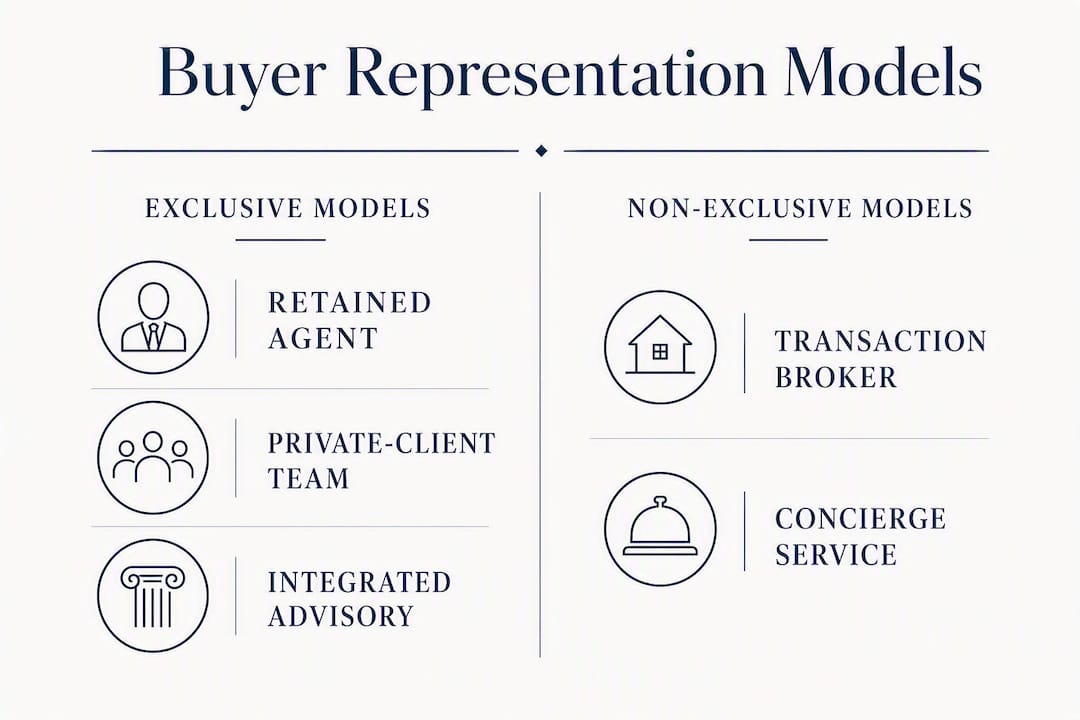
The three models that consistently serve luxury buyers best:
- Retained exclusive buyer's agent — best when privacy and undivided loyalty are the primary concern; the agent works solely for you, with no seller-side conflict.
- Private-client / in-house team — best when concierge coordination, off-market inventory depth, and wealth-advisory integration matter as much as the property itself.
- Integrated advisory / buyer consultant — best for buyers whose acquisition is part of a broader wealth or estate strategy, requiring coordination with family offices, private banks, or legal counsel.
Pro Tip: A generic agent's mistakes at the luxury tier can cost buyers significant sums in lost negotiating value or due-diligence oversights. Specialist representation is not a premium; it is risk mitigation.
Table of Contents
- What does buyer representation legally mean in the U.S. luxury market?
- Which buyer representation models work best in luxury real estate?
- How do the representation types compare at a glance?
- How do you verify a luxury buyer representative before signing?
- What should you expect in buyer-broker agreements and fee structures?
- What does the luxury buying process actually look like, from search to closing?
- What red flags should you watch for in luxury transactions?
- Key Takeaways
- Why boutique off-market specialists change the outcome
- Yhluxrealestate brings boutique off-market representation to Las Vegas luxury buyers
- Useful sources
- FAQ
What does buyer representation legally mean in the U.S. luxury market?
Buyer representation, formally known as buyer's agency, is a legal relationship in which a licensed real estate professional represents the purchaser's interests exclusively throughout a transaction. The agent's fiduciary duties are specific and binding: confidentiality (protecting the buyer's financial position and motivations), loyalty (placing the buyer's interests above all others), full disclosure (surfacing any material facts that affect the decision), and diligent presentation of all offers and counteroffers.
These duties are not aspirational standards; they are legally enforceable obligations that distinguish a buyer's agent from a transaction facilitator or a seller's representative. At the luxury tier, where a single negotiating misstep can carry six-figure consequences, the fiduciary relationship is the foundational reason to engage dedicated representation rather than relying on the listing agent.
The 2024 National Association of Realtors (NAR) settlement introduced a structural shift that every luxury buyer should understand. Since the settlement, buyers are now typically required to sign a written buyer representation agreement before touring properties, and compensation terms must be explicitly negotiated and disclosed in that agreement rather than assumed from the MLS commission structure. For high-net-worth buyers, this change is largely favorable: it forces transparency, clarifies exactly what the agent will do and what they will earn, and eliminates the ambiguity that once allowed undisclosed conflicts to persist.
What this means in practice:
- Before the first showing, expect to review and sign a written buyer representation agreement specifying the agent's scope, the compensation structure, and the agreement's term.
- Compensation is now negotiable and must be stated in writing; the seller is no longer automatically obligated to pay the buyer's agent fee.
- Luxury buyers should treat this agreement as a contract worth negotiating, not a formality to sign quickly.
Which buyer representation models work best in luxury real estate?
The luxury market accommodates several distinct representation structures, each calibrated to a different buyer profile and set of priorities. Understanding what each model actually delivers, rather than what it promises, is the first discipline of a sophisticated acquisition.
Exclusive / retained buyer's agent
The retained model places a single agent in an unambiguous fiduciary relationship with the buyer, often formalized with a retainer fee paid at engagement. The agent's mandate is narrow and absolute: source, evaluate, and negotiate on behalf of the buyer alone. No seller-side assignments, no dual-agency arrangements, no divided attention.

This model excels when privacy is paramount. The agent controls information flow, manages the buyer's identity in initial outreach, and structures offers to minimize exposure of the buyer's financial ceiling. For buyers acquiring a primary residence or a trophy asset where discretion is non-negotiable, this is the de rigueur choice.
Pros: Undivided loyalty; strongest fiduciary protection; full confidentiality of buyer's financial position. Cons: Retainer fees add upfront cost; the agent's off-market network may be narrower than a large private-client desk. Best for: Privacy-focused buyers, high-profile individuals, and anyone acquiring a property where identity exposure could inflate the asking price.
Private-client / in-house team
Large luxury brokerages and boutique firms with established private-client desks offer a team-based model in which a lead agent is supported by researchers, concierge coordinators, and off-market sourcing specialists. Leading luxury firms position off-market access and private-client infrastructure as their most differentiated service, and for good reason: the depth of an institutional network often surfaces inventory that no individual agent could locate independently.

This model suits buyers who want a managed, white-glove experience from initial search through post-closing coordination. Relocation concierge services, lifestyle advisory, and connections to vetted vendors (architects, designers, security consultants) are typically embedded in the engagement.
Pros: Deep off-market inventory; concierge coordination; institutional network depth. Cons: The "team" dynamic can dilute personal accountability; confirm which individual holds fiduciary responsibility. Best for: Out-of-state or international buyers, those relocating with families, and buyers who want a single point of coordination for the entire acquisition and transition.
Integrated advisory / buyer consultant
At the intersection of real estate and wealth management, the integrated advisory model positions the agent as a strategic coordinator rather than a transaction facilitator. Top brokerage models have shifted toward this structure, with agents coordinating directly with family offices, private banks, and estate attorneys to align the acquisition with broader wealth-transition objectives. The agent's network, in this context, is as consequential as personal negotiation skill.
Pros: Holistic wealth-strategy alignment; sophisticated ownership-structure guidance; access to private financing pathways. Cons: Requires an agent with genuine institutional relationships, not merely a claimed network. Best for: Buyers acquiring through trusts, LLCs, or family partnerships; those whose purchase is part of a tax-optimization or estate-planning strategy.
Transaction broker / dual agency
A transaction broker facilitates the deal without representing either party exclusively; a dual agent represents both buyer and seller in the same transaction. Both arrangements present structural conflicts of interest that are particularly acute at the luxury tier, where the financial stakes of undisclosed information are highest. Luxury buyer services consistently emphasize that buyers at the $3M+ level should avoid dual agency unless the circumstances are extraordinary and the conflict is fully disclosed in writing.
Pros: Can simplify communication in straightforward transactions. Cons: No fiduciary loyalty to the buyer; confidentiality is compromised by definition. Best for: Generally unsuitable for privacy-focused luxury buyers; acceptable only in limited, fully disclosed circumstances.
Concierge / relocation and full-service search management
Some firms offer a subscription or retainer-based concierge model that extends well beyond property search: school placement, vendor coordination, neighborhood orientation, and lifestyle advisory are bundled into the engagement. This model is particularly well-suited to buyers relocating from out of state, where the unfamiliarity of a new market amplifies the value of curated local intelligence.
Pros: Comprehensive lifestyle coordination; reduces the cognitive load of relocation; strong post-closing support. Cons: Retainer costs can be substantial; the breadth of services may dilute focus on pure negotiation execution. Best for: Families relocating across state lines, buyers unfamiliar with the target market, and those who value lifestyle continuity as much as the property itself.
How do the representation types compare at a glance?
| Representation Model | Privacy / Discretion | Off-Market Access | Negotiation Strength | Advisory Depth | Typical Fee Structure | Best Buyer Profile |
|---|---|---|---|---|---|---|
| Exclusive / retained buyer's agent | Highest | Moderate to high | Highest | Moderate | Retainer + commission | Privacy-focused; high-profile buyers |
| Private-client / in-house team | High | Highest | High | High | Commission; retainer optional | Relocating buyers; concierge-driven |
| Integrated advisory / buyer consultant | High | High | High | Highest | Advisory fee + commission | Wealth-strategy buyers; trust/LLC acquisitions |
| Transaction broker / dual agency | Low | Moderate | Low | Low | Commission split | Not recommended for luxury buyers |
| Concierge / relocation manager | Moderate | Moderate to high | Moderate | Moderate | Retainer or subscription | Out-of-state; lifestyle-transition buyers |
The retained exclusive model and the private-client team consistently score highest for privacy and execution certainty. Dual agency sits at the opposite end of the spectrum and warrants serious caution for any buyer whose financial position or identity is sensitive.
How do you verify a luxury buyer representative before signing?
The credential gap between a capable luxury specialist and a generalist agent who occasionally sells expensive homes is wide, and the consequences of misidentifying one for the other are measured in dollars and discretion. A structured verification process is not optional at this tier; it is the first act of due diligence.
The following 12-point checklist distills the verification standards that Own Luxury Homes® recommends for buyers at the luxury tier:
- Documented closed sales at your price tier in the past 12 months. Request the last five closed transactions above your target price, with addresses and closing dates. Volume without price-tier relevance is meaningless.
- Active off-market inventory access. Ask for specific examples of off-market properties the agent has sourced in the past six months, with enough detail to verify.
- Private lender and jumbo-loan contacts. The agent should name specific private banks or portfolio lenders they have closed transactions with, not generic referrals.
- References from buyers at your price tier. Anonymized references are acceptable given privacy norms; the agent should be able to provide at least two.
- Fiduciary disclosure in writing. Confirm the agent will operate as an exclusive buyer's agent, not a transaction broker or dual agent, and that this is stated in the representation agreement.
- Dual-agency policy. Ask directly: "Will you ever represent the seller in a transaction you bring to me?" The answer should be an unambiguous no.
- Escrow and closing support team. Identify who handles title, escrow, and closing coordination, and whether the team has experience with trust or LLC acquisitions.
- Inspection and specialist network. The agent should maintain relationships with estate-grade inspectors, structural engineers, and environmental consultants, not a single generalist inspector.
- Ownership-structure experience. If you are acquiring through a trust, LLC, or family partnership, confirm the agent has closed transactions in those structures and can coordinate with your legal counsel.
- Insurance and appraisal contacts. High-value properties require specialty insurers and appraisers with luxury-tier experience; the agent should have established relationships with both.
- Confidentiality protocol for initial seller outreach. Ask how the agent protects your identity and financial position when making initial contact with sellers or listing agents.
- Termination clause in the representation agreement. Confirm you can exit the agreement if the agent fails to perform, without penalty, after a reasonable notice period.
The exact questions that surface the most useful answers:
- "Show me the last five properties you closed above [your price tier] and tell me how you sourced each one."
- "How do you position a financed offer to compete with cash at this price level?"
- "What is your protocol if you identify a property where you also have a relationship with the seller?"
Pro Tip: To verify claimed closed sales, cross-reference the agent's stated transactions against public county recorder records or a title company search. Redacted settlement statements are an acceptable alternative when privacy concerns prevent full disclosure. An agent who resists this request is signaling something worth noting.
What should you expect in buyer-broker agreements and fee structures?
Luxury buyer-broker agreements carry more negotiating surface than most buyers realize, and the post-NAR settlement environment has made that surface explicit. Compensation is no longer embedded in the MLS; it is a line item in a contract, which means it is negotiable.
The most common fee structures at the luxury tier:
Retainer plus commission: The buyer pays an upfront retainer (often $5,000–$25,000 at the high-end luxury tier, though amounts vary by firm and market) that is credited against the commission at closing. This structure aligns incentives and signals serious buyer intent to the agent.
Flat advisory fee: Some buyer consultants charge a fixed fee for the full advisory engagement, independent of the transaction price. This model eliminates the commission-size incentive and is preferred by buyers who want purely objective counsel.
Success fee / negotiated commission: A percentage of the purchase price, negotiated in the written agreement. Post-settlement, this figure is no longer assumed; it must be stated and agreed upon before any tours.
Key contract clauses to review with counsel before signing:
- Scope of services: What exactly is the agent obligated to do? Off-market sourcing, inspection coordination, and ownership-structure advisory should be enumerated, not implied.
- Exclusivity and term: How long does the agreement run, and does it cover all properties or only those the agent introduces? A 90-day term with a renewal option is reasonable; an open-ended exclusive is not.
- Compensation and refund triggers: Under what circumstances is the retainer refundable? What happens if the buyer finds a property independently?
- Confidentiality clause: The agreement should explicitly protect the buyer's financial position, identity, and acquisition criteria from disclosure to any third party, including the seller.
- Termination provision: A clean exit clause, exercisable with 15–30 days' written notice, is a standard protection worth insisting upon.
- Dual-agency prohibition: If the agent's firm also represents sellers, the agreement should prohibit dual agency in any transaction the agent brings to the buyer.
A sophisticated agent managing a financed offer at the multi-million-dollar luxury tier will also coordinate appraisal pathways and lender escalation contacts to present the buyer as reliably as a cash offer. This execution-certainty work is invisible to most buyers but is often the difference between a winning and losing bid in a competitive off-market situation.
What does the luxury buying process actually look like, from search to closing?
The timeline and due-diligence scope for a luxury acquisition differ materially from a standard residential transaction, and buyers who approach the process with standard-market expectations tend to encounter costly surprises.
At the high-end luxury tier, all-cash closings typically complete within 7–10 days; financed buyers should plan for an extended timeline (30–35 days) due to appraisal and underwriting, with the possibility of multiple appraisals and extended underwriting review. A well-prepared buyer's agent will have pre-negotiated the appraisal pathway and staged inspection contingencies to make the financed timeline credible to sellers accustomed to cash offers.
| Phase | Typical Duration | Key Activities |
|---|---|---|
| Search and sourcing | several weeks | Off-market outreach, private network canvassing, MLS review |
| Offer and negotiation | a few days | Offer structuring, execution-certainty documentation, counteroffer management |
| Inspection and due diligence | several weeks | Estate-grade inspection, environmental assessment, specialty appraisal |
| Financing and underwriting | several weeks for financed buyers | Jumbo loan processing, multiple appraisals, lender escalation |
| Title and ownership review | about one to two weeks | Title search, lien clearance, trust/LLC structure review |
| Closing | a few days | Escrow settlement, deed recording, final walkthrough |
Expanded due diligence at the luxury tier routinely includes:
- Estate-grade mechanical, electrical, and structural inspections by specialist engineers, not generalist home inspectors.
- Environmental assessments covering soil, water quality, and flood-zone status (the FEMA Flood Map Service Center is the primary reference for flood-risk verification).
- Specialty appraisals for art installations, wine cellars, smart-home systems, and other bespoke features that a standard appraiser may not value accurately.
- Provenance research on significant architectural elements, art, or fixtures included in the sale.
- Ownership-structure review: if the property is held in a trust or LLC, the buyer's counsel must confirm clean title transfer and any tax implications.
- Premium title endorsements and high-value homeowner insurance underwriting, both of which require longer lead times than standard policies.
Additional costs to budget beyond the purchase price: specialty inspection fees, environmental consultant retainers, premium appraisal fees, upgraded title endorsements, and high-value homeowner insurance premiums. Buyers acquiring through complex ownership structures should also budget for legal counsel to review the transfer documentation.
What red flags should you watch for in luxury transactions?
The most consequential risks in a luxury acquisition are rarely visible in the listing. They surface in the agent's behavior, the due-diligence process, and the contract terms, and a well-prepared buyer's representative should be actively scanning for all of them.
Red flags that warrant immediate scrutiny:
- An agent who cannot produce verifiable closed sales at your price tier in the past 12 months. Claimed expertise without documented proof is the most common misrepresentation in the luxury segment.
- Over-reliance on MLS inventory as the primary sourcing strategy. At the luxury tier, the most desirable properties often never reach public listing; an agent whose search begins and ends with the MLS is operating with a fraction of the available inventory.
- Vague or evasive answers about private lender relationships. A genuine luxury specialist maintains named contacts at portfolio lenders and private banks, not a generic referral to "several lenders I work with."
- Unexplained gaps in inspection reports, particularly around mechanical systems, structural elements, or environmental conditions. At estate scale, these gaps are rarely accidental.
- Seller-funded concessions with unusual terms, particularly those structured to obscure the effective purchase price from the appraiser.
- Any undisclosed relationship between the agent and the seller, the listing agent, or the seller's lender.
Practical mitigations your representative should implement:
- Staged confidentiality agreements with sellers before disclosing the buyer's identity or financial capacity.
- Escrow protection strategies that hold funds in a neutral account until all contingencies are satisfied.
- Targeted engineering and environmental consultants selected for the specific property type, not a default vendor list.
- Pre-approval documentation structured to demonstrate execution certainty without revealing the buyer's maximum capacity.
Pro Tip: When making initial contact with a seller through your agent, structure the outreach so that the buyer's identity is withheld until a confidentiality agreement is in place. For financed offers, provide a pre-approval letter that confirms capacity at the offer price without disclosing the buyer's full financial picture. This positions the offer as credible without surrendering negotiating leverage.
Key Takeaways
The retained exclusive buyer's agent or private-client in-house team is the most protective and effective representation model for privacy-focused luxury buyers, provided the agent can document verifiable closed sales at your price tier and demonstrate genuine off-market access.
| Point | Details |
|---|---|
| Fiduciary duty is the foundation | Only an exclusive buyer's agent owes full fiduciary loyalty; dual agency and transaction brokers do not. |
| Off-market access defines the field | The most coveted luxury inventory rarely appears on the MLS; the agent's private network determines what you can actually buy. |
| Verify with closed-sales proof | Request the last five closed transactions above your price tier in the past 12 months before signing any agreement. |
| Execution certainty matters for financed buyers | At the ultra-luxury tier, all-cash closings typically complete within 7–10 days; a skilled agent can position financed offers to compete by managing appraisal and underwriting risk. |
| Yhluxrealestate's boutique model | Yhluxrealestate offers retained off-market buyer representation in Las Vegas with relocation concierge services and a global network through Sotheby's International Realty. |
Why boutique off-market specialists change the outcome
The conventional wisdom in luxury real estate holds that the largest brokerage with the widest reach is the safest choice for a high-value acquisition. That framing, while understandable, inverts the actual value hierarchy for buyers.
At the $3M–$10M+ tier, the buyer's primary need is not exposure to more listings; it is curated access to the right properties, managed with the discretion that protects both identity and negotiating position. A boutique specialist who maintains genuine off-market relationships, pre-vetted financing pathways, and a disciplined confidentiality protocol will consistently outperform a high-volume generalist who happens to operate in the luxury segment.
The verification checklist in this guide exists precisely because the credential gap is real and the consequences of misidentifying a generalist as a specialist are measured in lost value, not inconvenience. When a buyer in a competitive off-market situation loses a property because their agent could not credibly position a financed offer, or when a due-diligence gap surfaces after closing, the cost is rarely recoverable.
The boutique model, at its best, treats the acquisition as a wealth-management event: private sourcing, structured due diligence, ownership-structure coordination, and post-closing continuity. That is the standard worth holding any representative to, regardless of the firm's size or brand recognition.
Yhluxrealestate brings boutique off-market representation to Las Vegas luxury buyers
For buyers who have read this guide and recognize the gap between generalist service and genuine luxury representation, Yhluxrealestate offers exactly the model this article describes: retained, off-market buyer representation in Las Vegas, backed by Sotheby's International Realty's global network and a relocation concierge designed for out-of-state buyers who need more than a property search.

Yelena Horton's practice is built on the three pillars that matter most at the luxury tier: exclusive access to properties that never reach public listing, negotiation strategies that protect the buyer's position from first contact through closing, and a concierge infrastructure that coordinates the full transition, from financing introductions to lifestyle advisory. Verification documents, including redacted closed-sales proof at your price tier and private-lender contacts, are available upon request.
To schedule a verification call or request the 12-point audit packet, contact Yhluxrealestate directly. The conversation begins with your priorities, not a listing presentation.
Useful sources
The following sources informed this guide and are worth consulting directly for legal context, verification standards, and market-specific practices:
- What Is Buyer's Representation? | HL Real Estate Network: The clearest primer on fiduciary duties and the practical impact of the 2024 NAR settlement on written buyer representation agreements.
- Best Agent for Luxury Home Buyers | Own Luxury Homes®: The most detailed publicly available verification standard for luxury buyer agents, including the recommendation to request the last five closed transactions above your price tier.
- Buying a $10M+ Bay Area Estate | MK Bay Area: Concrete case examples of execution-certainty tactics for financed buyers competing against cash offers at the $10M+ tier.
- About Us | LuxuryProperty.com: Institutional perspective on how leading luxury firms position off-market access and private-client infrastructure as their primary differentiator.
- FEMA Flood Map Service Center: The primary government reference for flood-zone verification during luxury property due diligence.
- HUD Fair Housing Rights and Obligations: Federal fair housing framework applicable to all U.S. real estate transactions, including luxury acquisitions.
Buyers are encouraged to ask any prospective agent for redacted verification materials, specifically closed-sale documentation and references, rather than relying on marketing copy or self-reported credentials. The sources above provide the independent context needed to evaluate what those materials should contain.
FAQ
What is the most common type of buyer representation agreement?
The exclusive buyer representation agreement is the most widely used format in the U.S. luxury market; since the 2024 NAR settlement, it must be signed in writing before touring properties and must specify compensation terms.
What are the main types of buyers in the luxury market?
Luxury buyers generally fall into four profiles: primary-residence acquirers seeking privacy and lifestyle, investment buyers focused on asset performance and exit strategy, relocating buyers who need concierge coordination, and estate or trust buyers whose acquisition is part of a broader wealth-transition plan.
What is the best way to verify a luxury buyer's agent?
Request the last five closed transactions above your target price tier in the past 12 months, cross-reference them against public county recorder records, and ask directly for the agent's private-lender contacts and off-market sourcing examples.
How does Yhluxrealestate handle off-market access for buyers?
Yhluxrealestate maintains exclusive access to off-market Las Vegas luxury properties through Sotheby's International Realty's global private-client network, providing buyers with inventory that never reaches public listing and a relocation concierge for out-of-state acquisitions.
What is the 3-3-3 rule in real estate?
The 3-3-3 rule is not a standardized industry framework with a single canonical definition; interpretations vary by practitioner and context. When evaluating luxury representation, focus instead on verifiable closed-sales proof, fiduciary clarity, and documented off-market access as the concrete standards that actually govern agent performance.