
Diversifying into real estate strengthens a portfolio by adding durable income, low-to-moderate correlation with equities, inflation protection, and leverage options that compound long-term returns in ways that stocks and bonds alone cannot replicate. The case, well-documented by institutions from J.P. Morgan Asset Management to Goldman Sachs Asset Management, rests on five pillars that every serious investor should understand before allocating capital:
- Income and cash flow derived from rents and lease structures, independent of equity-market sentiment
- Portfolio diversification through low-to-moderate correlation with the S&P 500, particularly for direct and private real estate
- Inflation protection via rent escalators, replacement-cost dynamics, and NOI growth that has historically outpaced CPI
- Tax advantages including depreciation deductions and 1031 exchange treatment that improve after-tax returns
- Leverage that allows investors to control larger assets with a fraction of the capital, multiplying equity returns as mortgages amortize
The NCREIF Property Index, a benchmark for institutional direct real estate, has tracked these characteristics across multiple market cycles, giving investors a long-run data set that supports the allocation case. The sections that follow unpack each benefit, the vehicles available, the risks to weigh, and a practical playbook for implementation.
Table of Contents
- What are the detailed benefits of adding real estate?
- How can you access real estate exposure?
- What risks and trade-offs come with real estate?
- How should you implement a real estate allocation?
- Which real estate sectors offer the strongest prospects now?
- How do you measure whether your real estate allocation is working?
- Key Takeaways
- Why private exposure often outperforms public real estate over a full cycle
- Useful sources
- FAQ
What are the detailed benefits of adding real estate?
Rental income and cash flow
Property-level cash flow, expressed as NOI after operating expenses but before debt service, is the foundational benefit that separates real estate from growth-oriented equities. Long-term leases, particularly in commercial sectors such as industrial and multifamily, lock in contractual income streams that persist through equity-market turbulence. A stabilized multifamily property with high occupancy generates monthly rent rolls that compound over years, independent of whether the Nasdaq is rising or falling. This predictability is what makes real estate a de rigueur component of institutional endowment and pension portfolios.
Inflation hedge
Real estate's inflation-hedging mechanism operates on three levels simultaneously. Rent escalation clauses, common in commercial leases, pass inflation through to income. Replacement-cost dynamics support property values when construction costs rise, constraining new supply and underpinning existing asset prices. And NOI growth, as tracked by the NCREIF Property Index, has historically outpaced inflation over long periods, according to Goldman Sachs Asset Management's analysis of commercial real estate fundamentals. Together, these forces make real estate one of the few asset classes where the income stream and the asset value both tend to rise with inflation rather than erode under it.

Leverage and capital growth
Mortgage financing allows investors to control an asset worth multiples of their equity contribution. Consider a simplified example: a $1,000,000 property acquired with $250,000 in equity and a $750,000 mortgage. If the property appreciates 20% to $1,200,000, the investor's equity grows from $250,000 to $450,000, an 80% return on invested capital, while the absolute appreciation was only 20%. As Investopedia explains, mortgage amortization adds a second layer of return: each payment reduces the outstanding balance, building equity even when property values are flat. Exploring leverage strategies for property investors in depth reveals how disciplined use of debt, rather than speculative over-leverage, is what separates durable wealth builders from distressed sellers.
How can you access real estate exposure?
Different vehicles trade off liquidity, control, fees, and minimum capital in ways that make each suited to a distinct investor profile. The choice of vehicle is as consequential as the decision to allocate to real estate at all.
| Vehicle | Diversification / Correlation | Income Potential | Liquidity | Capital Requirement | Management Intensity | Typical Fees | Suitable Investor |
|---|---|---|---|---|---|---|---|
| Direct ownership | Lowest correlation; property-specific | High (NOI-driven) | Very low | High ($250K+) | High | Closing costs 2–5%; ongoing maintenance | Accredited / HNW |
| REITs / REIT ETFs | Moderate; partial equity correlation | Moderate-high; dividend distributions | Daily (exchange-traded) | Low ($500+) | None | Expense ratios vary, commonly below 1% | Retail / institutional |
| Private real estate equity funds | Low; private-market pricing | High; distributions + appreciation | Low; lock-ups 3–10 years | High (above $100,000) | High | 1–2% management; 20% carry | Accredited / institutional |
| Real estate debt / credit | Very low equity correlation | Moderate-high; interest income | Low-moderate | Moderate ($25K+) | Low | Typical management fees around 1% | Accredited / institutional |
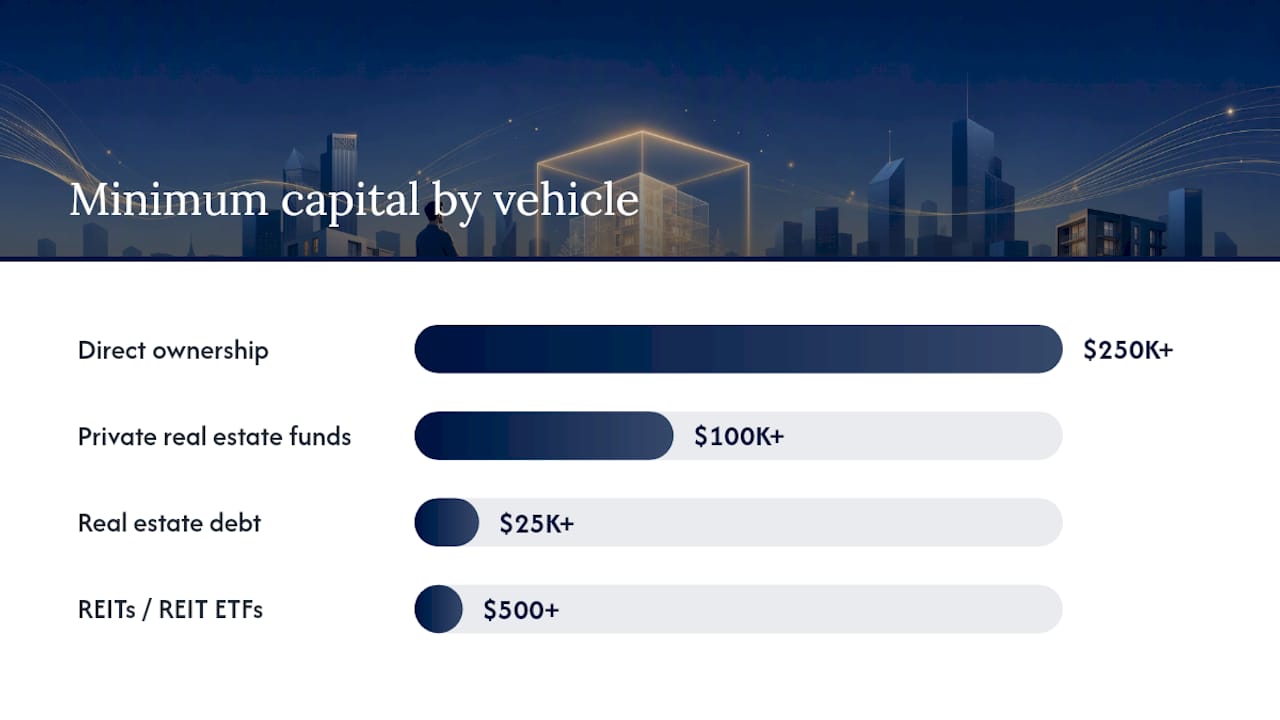
REITs provide liquid access to a broad set of property types, with income that sits between equities and bonds, making them the natural entry point for retail investors or those who need to preserve liquidity. Browsing publicly traded REIT options by sector reveals how listed vehicles span industrial, multifamily, data centers, healthcare, and retail, offering granular sector exposure without the capital intensity of direct ownership.
Private real estate equity funds offer deeper diversification from public markets, as Forbes notes, with the trade-off of multi-year lock-ups and higher minimum investments. Private real estate credit occupies a particularly attractive niche: it offers defensive yield characteristics, very low correlation to equities, and priority claim on assets in the capital stack, making it a compelling complement to both fixed income and equity real estate.
- Retail investors — with liquidity needs: REITs and REIT ETFs
What risks and trade-offs come with real estate?
Real estate adds risk types that differ fundamentally from equity and fixed-income risk, and understanding them before allocating is the mark of a disciplined investor. The primary risks, in order of materiality for most portfolios, are as follows:
- Concentration risk: FINRA cautions investors that over-allocating to illiquid assets creates portfolio fragility; a single large property or a single private fund can represent an outsized share of net worth.
- Operational and management burden: — Direct ownership demands active engagement with maintenance, tenants, insurance, and local regulations. This burden is frequently underestimated by investors accustomed to passive equity portfolios.
Pro Tip: Manage real estate illiquidity at the portfolio level by maintaining a liquidity ladder: hold REITs or REIT ETFs as the liquid layer, private equity funds as the core illiquid layer, and direct holdings as the long-duration anchor. This structure allows rebalancing and liquidity access without forcing a distressed sale of hard assets.
How should you implement a real estate allocation?
Allocation sizing
Most individual investors with diversified portfolios find that a moderate allocation to real estate provides meaningful diversification and income benefits without creating excessive illiquidity. Institutional investors, including endowments and pension funds, often carry allocations of 10–25% or more, reflecting their longer time horizons and greater access to private markets. The right number for any investor depends on time horizon, liquidity needs, risk tolerance, access to quality managers, tax situation, and existing portfolio composition.
Decision factors worth assessing before committing capital:
- Liquidity needs: — Investors who may need capital within 2–3 years should limit illiquid allocations and favor REITs.
Due-diligence checklist
Before committing to any real estate investment, a disciplined review should cover:
- Manager track record across at least one full market cycle (vintage years matter)
- Current occupancy rates and weighted average lease expiration (WALE)
- NOI trends over the prior 3–5 years and forward projections
- Tenant concentration (no single tenant should represent an outsized share of income)
- Local market fundamentals: supply pipeline, employment trends, population growth
- Financing terms: fixed vs. floating rate, loan-to-value ratio, maturity schedule
- Fund-level fees: management fee, carried interest, preferred return hurdle, and redemption/lock-up terms
Pro Tip: If you lack direct real estate operating experience, favor passive vehicles (REITs, private funds with experienced operators) over direct ownership. The value-add strategies that generate the highest returns also carry the highest execution risk; an experienced operator's track record is the most reliable predictor of whether that risk is being managed.
Which real estate sectors offer the strongest prospects now?
Sectors exposed to e-commerce logistics, cloud and AI infrastructure, and structural housing demand show the most durable fundamentals; office continues to face headwinds that make it a selective, rather than core, allocation for most investors.
| Sector | Demand Drivers | NOI / Occupancy Trend | Income Profile | Access Vehicle |
|---|---|---|---|---|
| Industrial / logistics | E-commerce, nearshoring, supply-chain reconfiguration | Strong; low vacancy in major markets | High; long-term leases with rent escalators | REITs, private funds |
| Data centers | Cloud computing, AI infrastructure buildout | Very strong; constrained supply | High; long-term contracts | REITs, private funds |
| Multifamily | Housing affordability constraints, population growth | Stable; rent growth moderating but positive | Moderate-high; monthly rents | REITs, direct, private funds |
| Self-storage | Life transitions, urban density, small-business demand | Stable; resilient through cycles | Moderate; shorter lease terms | REITs, private funds |
| Office | Remote/hybrid work adoption | Weak; elevated vacancy in many markets | Variable; lease rollover risk elevated | Selective only; value-add strategies |
| Retail (necessity-based) | Grocery, healthcare, discount anchors | Stable; bifurcated by tenant quality | Moderate; long leases with credit tenants | REITs, direct |
Statistic callout: Goldman Sachs Asset Management's analysis of commercial real estate highlights that industrial and data-center sectors benefit from constrained supply pipelines and long-duration lease structures, creating NOI visibility that supports both income and valuation stability. U.S. Bank Asset Management similarly notes that sector selection within REITs materially affects income and correlation outcomes.
For income-focused investors, industrial and multifamily offer the most predictable cash flows. Growth-oriented investors may find data-center and life-science sectors compelling, though access often requires private funds with institutional minimums. Office exposure, where warranted at all, is best approached through value-add strategies targeting well-located, amenity-rich assets rather than commodity suburban product.
Goldman Sachs Asset Management's commercial real estate analysis reinforces the case for blending public and private exposure across these sectors, capturing both the liquidity of listed REITs and the return premium available in private markets.
How do you measure whether your real estate allocation is working?
The allocation is performing as intended when it delivers cash-on-cash yield consistent with underwriting, NOI growth at or above inflation, stable occupancy, and a measurable reduction in overall portfolio volatility relative to a pure equity/bond portfolio. These are the metrics that matter, and they require a structured monitoring cadence to track reliably.
A practical monitoring framework:
- Monthly: Review cash flow statements for direct holdings; confirm distributions received from REITs and funds; flag any tenant delinquencies or vacancy events.
- Quarterly: Review NAV statements and distribution reports for private funds; compare NOI trends against underwriting assumptions; assess portfolio-level allocation drift and rebalancing needs.
- Annually: Commission or review independent valuations for direct holdings; evaluate cap-rate movement in the relevant market; assess whether the allocation's correlation and income contribution remain aligned with portfolio objectives.
Red flags that warrant a deeper review:
- A sharp or sustained decline in NOI without a clear, temporary cause
- Rising tenant concentration above 20–25% of total income from a single tenant
- Persistent vacancy above the market average for the property type and submarket
- Significant changes in fund manager team composition or strategy
- Loan-to-value ratios approaching covenant thresholds on floating-rate debt
Incorporating real estate performance into overall portfolio reporting requires consistent valuation methodology. Private assets are typically marked quarterly by fund managers; direct holdings require periodic appraisals. Investors should set rebalancing triggers, such as the real estate allocation drifting more than 3–5 percentage points from target, and maintain liquidity buffers sufficient to fund at least 12 months of operating expenses on direct holdings without requiring asset sales.
Key Takeaways
Real estate's most durable portfolio contribution is defensive income that persists through equity-market cycles, combined with low-to-moderate correlation that genuinely reduces portfolio volatility when the allocation is sized and structured with discipline.
| Point | Details |
|---|---|
| Core diversification benefit | Low-to-moderate correlation with equities creates a distinct return stream that reduces portfolio volatility. |
| Allocation range | Individual investors typically benefit from a 5–10% allocation; institutions often carry 10–25% or more. |
| Tax efficiency | Depreciation schedules (27.5 years residential, 39 years commercial) and 1031 exchanges materially improve after-tax returns. |
| Sector selection matters | Industrial, data centers, and multifamily show stronger fundamentals; office requires selective, value-add approaches. |
| Liquidity requires active management | Maintain a liquidity ladder of REITs, private funds, and direct holdings to avoid forced sales of illiquid assets. |
Why private exposure often outperforms public real estate over a full cycle
The conventional wisdom holds that REITs are the simplest path to real estate diversification, and for many investors they are. What that framing misses, though, is that listed REITs trade with partial equity-market correlation, particularly during periods of broad risk-off selling, which is precisely when investors most want their real estate allocation to behave differently from their stock portfolio. Private real estate, by contrast, is valued on fundamentals rather than daily sentiment, and its income stream continues to compound regardless of what the public market is pricing.
The practical implication for high-net-worth investors is that the most resilient allocations blend both. REITs provide the liquidity layer and sector breadth; private equity funds and direct holdings provide the low-correlation, income-compounding core. The blend is not a compromise; it is the structure that captures the full range of real estate's portfolio benefits.
For investors considering direct property in markets with genuine scarcity and income potential, Las Vegas stands as a compelling case study: a city with no state income tax, strong population inflows, and a luxury property market where off-market access can mean the difference between acquiring a generational asset and watching it transfer to another buyer. Yhluxrealestate, through Yelena Horton's exclusive access to off-market luxury properties and a relocation concierge designed for out-of-state buyers, provides the kind of market intelligence and negotiation expertise that transforms a sound allocation thesis into a well-executed acquisition.

The investors who build lasting wealth through real estate are not those who time the market. They are those who select the right vehicle, the right sector, and the right market, and then hold with patience and discipline.
Useful sources
The following institutional and practitioner resources informed this article and merit direct review for investors conducting deeper due diligence:
- Direct Real Estate: Finding diversification and stable income | J.P. Morgan Asset Management
- Finding a firmer footing: The case for commercial real estate | Goldman Sachs Asset Management
- Key Reasons to Invest in Real Estate | Investopedia
- Adding Private Real Estate To Your Portfolio: Considerations For Investors | Forbes
- Diversifying Your Portfolio with Real Estate: Pros and Cons | Synovus
- Diversification with real estate investments | U.S. Bank Asset Management Group
- Concentration risk | FINRA
- Top 8 Benefits of Investing in Real Estate | TenantCloud
Paid manager research, local market appraisals, and qualified tax counsel are necessary before committing material capital to any real estate strategy. This article provides general information, not professional investment, tax, or legal advice; confirm current rules and suitability with a qualified advisor.
FAQ
What are the main benefits of diversifying into real estate?
Real estate adds durable income from rents and leases, low-to-moderate correlation with equities, inflation protection through rent escalators and NOI growth, tax advantages including depreciation and 1031 exchanges, and leverage that multiplies returns on invested capital.
What is the 3-3-3 rule in real estate?
The 3-3-3 rule is not a universally standardized framework; definitions vary across practitioners. A common version refers to evaluating a property across three time horizons, three return metrics, and three risk factors, though investors should confirm the specific definition with the source using it.
What is the 7% rule in real estate?
The 7% rule is an informal guideline suggesting that a property's annual rent should equal at least 7% of its purchase price to generate adequate cash flow; it is a rough screening tool, not a substitute for full NOI and cap-rate analysis.
What did Warren Buffett say about diversification?
Buffett has famously described diversification as "protection against ignorance," arguing that concentrated positions in well-understood businesses outperform broad diversification for sophisticated investors. For most investors, however, institutional research consistently supports diversification across asset classes, including real estate, as the more prudent path to risk-adjusted returns.
What are the core advantages of diversifying a portfolio with real estate?
The core advantages are reduced portfolio volatility through low equity correlation, a reliable income stream from rents and leases, inflation protection, meaningful tax efficiency, and the ability to use leverage to amplify returns, all of which are difficult to replicate through stocks and bonds alone.