
Asset-based mortgages let you qualify for a home loan using liquid assets, savings, brokerage holdings, retirement accounts, rather than the pay stubs and tax returns conventional underwriting demands. They suit retirees, recently exited founders, and high-net-worth buyers whose bank balance tells a far richer story than their tax return does. The trade-off is real: greater flexibility in qualifying, but typically a modest rate premium and heftier reserve requirements than a standard conventional loan.
TL;DR:
- Using shorter depletion periods, such as 60 months, can significantly increase qualifying income compared to longer amortization schedules used by agency programs.
- Reserves and retirement account haircuts can reduce eligible assets and impact the monthly income calculation, often requiring larger liquid reserves to qualify.
- Non-QM and portfolio lenders typically offer shorter depletion periods and more property type flexibility, but at higher rates and larger reserve requirements.
- Eligible assets generally include cash, brokerage accounts, and most retirement accounts, but exclude virtual currencies and recently borrowed or gifted funds without seasoning.
- Asset-based loans usually have a rate premium of 0.5% to 2.0% over conventional rates, with costs rising for higher LTV ratios, larger down payments, or cash-out scenarios.
Table of Contents
- How Asset-Based Mortgages Work: The Depletion Formula Explained
- Agency, Non-QM, and Jumbo Programs Compared
- What Assets Qualify, and What Documentation Lenders Require
- Rates, Fees, and the True Cost of Asset-Based Qualification
- The Application Process, Timeline, and Where Deals Go Wrong
- Choosing Between Asset-Based Qualification and Other Mortgage Loan Options
- An Advisor's Perspective on Financing and Timing for Luxury Buyers
- Sources
- FAQ
How Asset-Based Mortgages Work: The Depletion Formula Explained
Asset-based mortgages, sometimes called asset-depletion mortgages, run on a formula rather than a pay stub. Lenders take your eligible liquid assets, subtract the down payment, closing costs, and required post-closing reserves, then divide what remains by a set number of months. The result becomes your imputed monthly qualifying income, treated in underwriting much like a salary would be.
The formula looks like this: eligible assets minus down payment, closing costs, and reserves, then divided by a depletion period (a number of months) to calculate monthly qualifying income. That depletion period, the number of months a lender assumes you'll draw down the account, is the single biggest lever in the entire calculation, and it varies enormously by program.
Not every dollar in an account counts at full value. Retirement accounts often get a haircut to account for early-withdrawal penalties and taxes, before the remaining balance enters the formula. Fannie Mae's selling guide requires lenders to subtract those penalties from employment-related retirement assets before counting them.
Here's where the divisor changes everything. A $2 million eligible asset pool, after subtracting a $400,000 down payment and $100,000 in reserves, leaves $1.5 million to divide.
That's a six-fold swing in qualifying income from the same $1.5 million, based purely on which divisor a lender applies.
Two distinct underwriting paths exist here. The coverage route lets sufficient assets simply cover the loan balance outright, often skipping a debt-to-income calculation entirely. The income, or depletion, route divides assets into monthly income and runs that figure through standard DTI calculations, the same way a lender would treat a paycheck. Investment properties and cash-out scenarios usually require the income route.
Expect your bank, brokerage, and retirement statements to undergo third-party verification, and expect lenders to re-check balances close to closing. Assets used to qualify generally need to stay in place and available through the closing date; draining or transferring funds midway through underwriting is one of the fastest ways to derail an approval.
Agency, Non-QM, and Jumbo Programs Compared
Not all asset-based lending runs through the same rulebook, and the differences shape both your qualifying income and your closing costs.
Agency programs (Fannie Mae and Freddie Mac) apply the most conservative math. Fannie Mae's guidance typically divides net documented assets by a long amortization term, often 240 to 360 months, which produces a lower monthly qualifying income than shorter-window programs. Agency loans also carry firmer loan-to-value and occupancy limits, with some agency guidance capping LTV around 70%, extending to 80% for owner-occupants aged 62 and older in certain scenarios.
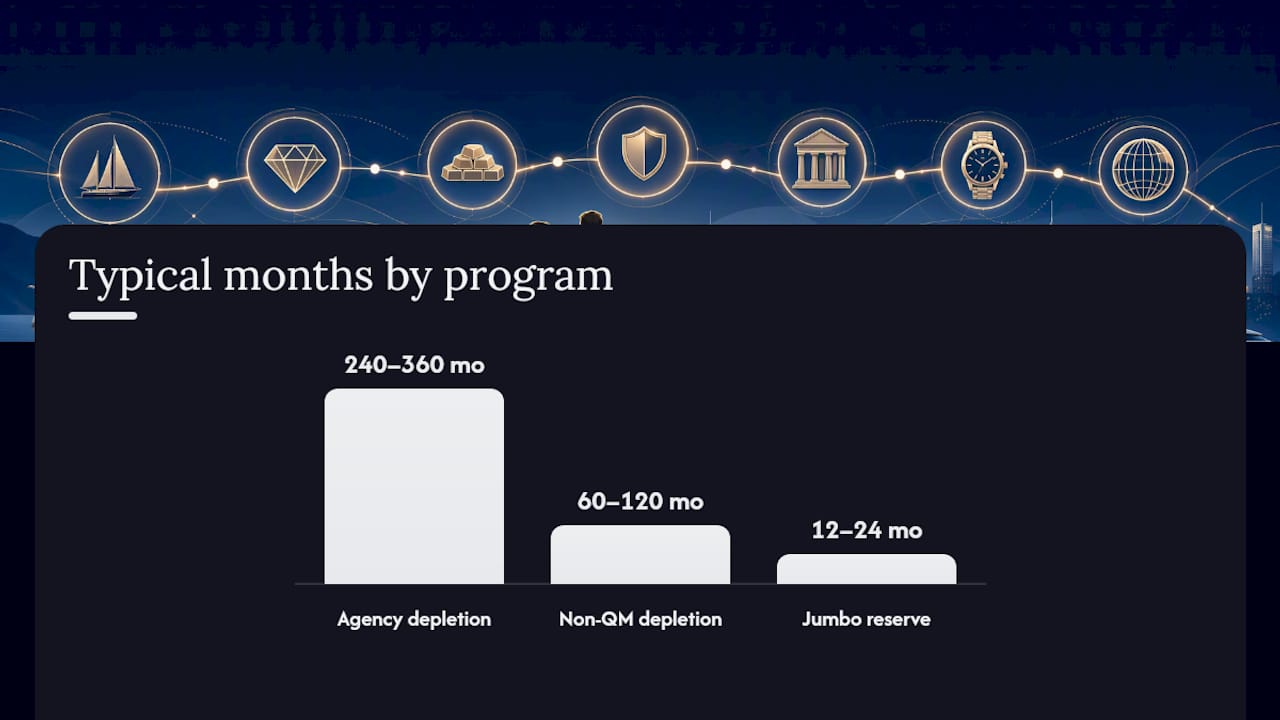
Non-QM and portfolio programs take a shorter view. These lenders commonly use depletion periods of just 60 to 120 months, which can double or triple your qualifying income compared to an agency calculation on the identical asset base. They also tend to offer more flexibility on property type, including second homes and investment properties, and on loan size.
Jumbo asset-based loans stack additional requirements on top of whichever route you choose. Expect larger down payments, deeper reserve requirements, often 12 to 24 months of payments held in reserve, and credit score expectations that run tighter than a standard conforming loan.
So which route fits? A few patterns hold up consistently:
- Agency programs suit buyers with very large asset pools who don't need maximum qualifying income and want the lowest available rate.
- Non-QM/portfolio programs suit buyers who need the shortest depletion period to hit a target purchase price or DTI.
- Jumbo asset-based programs suit high-value purchases beyond conforming loan limits where the buyer has substantial reserves beyond the down payment.
Agency rules are also in motion. Guidance updates moving through 2026 and 2027 are expected to adjust depletion divisors and age-related eligibility, so a program that penciled out favorably last year may look different by the time you apply.
What Assets Qualify, and What Documentation Lenders Require
Lenders are specific about which assets count and which don't, and the exclusions catch more borrowers off guard than the eligible list does.
Eligible assets typically include:
- Checking and savings account balances
- Brokerage and investment accounts, including stocks and bonds
- Retirement accounts (401(k), IRA), usually reduced by a penalty haircut
- Lump-sum retirement distributions once deposited into a non-retirement account
Ineligible or heavily restricted items commonly include:
- Cryptocurrency and other virtual currency holdings
- Pledged assets used as collateral elsewhere
- Recently borrowed or gifted funds without a seasoning history
- Non-liquid business equity or ownership stakes
Documentation runs deeper than a single account snapshot. Lenders generally want two to three months of statement history at minimum, sometimes longer, and they'll verify large or unexplained deposits directly with the account custodian. Funds need seasoning, meaning they've sat in the account long enough to establish they're genuinely yours and not a short-term loan dressed up as savings.
Fannie Mae's B3-3.4-06 guidance is worth reading directly if you're pursuing an agency loan, since it lays out exactly which employment-related assets qualify, how penalties get subtracted, and the ownership and age documentation lenders will request. Reserve requirements add another layer: most programs expect assets to remain available after closing, not just at the moment of approval, to demonstrate genuine ongoing financial cushion.
Pro Tip: Before you assume an account qualifies, ask your loan officer for the lender's specific haircut percentage on retirement assets and their required seasoning window. These two numbers vary more between lenders than almost any other part of the underwriting file, and they can swing your qualifying income by six figures.
Rates, Fees, and the True Cost of Asset-Based Qualification
Flexibility on the income side comes with a price tag on the rate side, and it's worth knowing that price before you commit to a lender.
Asset-based loans generally price in the non-QM band, running roughly 0.5% to 2.0% above comparable conventional rates. Where you land in that range depends heavily on credit score, down payment size, and loan-to-value ratio; strong credit and a substantial down payment can narrow the spread considerably, while thinner reserves or a higher LTV push you toward the top.
Loan purpose matters too. A straightforward purchase typically prices better than a cash-out refinance using the same asset base, and higher LTV requests draw more scrutiny and often a higher rate.
Beyond the rate itself, expect these cost factors to differ from a conventional loan:
- Larger required reserves, often well beyond a standard conventional loan's cushion
- Higher minimum down payments on many non-QM programs
- Additional documentation and verification fees tied to third-party asset checks
- Potentially higher closing costs reflecting the underwriting complexity
Asset-based loans typically carry a premium in the 0.5% to 2.0% range over conventional pricing, according to industry rate surveys, narrowing meaningfully for borrowers with strong credit and larger down payments.
The premium tends to be worth paying when it unlocks a purchase you couldn't otherwise document your way into, particularly for buyers whose wealth sits in brokerage accounts or a recent liquidity event rather than a W-2.
The Application Process, Timeline, and Where Deals Go Wrong
Applying for an asset-based mortgage follows a fairly predictable sequence, though the details shift depending on whether you land in an agency or non-QM program.
- Initial consultation. A loan officer reviews your asset mix and helps determine whether the coverage route or income/depletion route fits your situation.
- Statement collection and verification. You submit account statements, and the lender begins third-party verification with the custodians directly.
- Route and program determination. The lender calculates qualifying income using its depletion divisor and confirms whether an agency or non-QM program applies.
- Underwriting. The file moves through standard underwriting, including credit, reserves, and property appraisal, layered on top of the asset calculation.
- Final verification and closing. Lenders typically re-verify asset balances shortly before closing to confirm funds remain in place.
Timelines commonly run 14 to 45 business days depending on lender complexity and how quickly custodians respond to verification requests.
The pitfalls that derail these deals are almost always avoidable. Moving money between accounts mid-process, even for a routine reason, can trigger a fresh seasoning clock. Relying on an asset the lender later deems ineligible, like a recent large gift, can blow a hole in your qualifying income overnight. And borrowers sometimes underestimate reserve requirements, only to discover late in underwriting that they're short.
Pro Tip: Ask your loan officer for the lender's exact depletion divisor and haircut rules in writing before you submit a single statement. Getting those two numbers upfront lets you compare offers on equal footing instead of discovering the real math three weeks into underwriting.
Choosing Between Asset-Based Qualification and Other Mortgage Loan Options
Asset-based qualification isn't automatically your best path just because you have the assets to support it. A quick framework helps clarify the decision:
- Asset size relative to purchase price. If your liquid assets comfortably exceed what a shorter depletion period would require, a non-QM program likely maximizes your qualifying power.
- Documented income. If you can show two years of tax returns or steady bank-statement deposits, a bank-statement loan or conventional mortgage may price better than any asset-depletion program.
- Property type. Investment properties often need the income route, while a primary residence purchase may qualify through the simpler coverage route.
- Appetite for reserves and rate premium. If deep reserve requirements or a rate premium give you pause, compare against a DSCR loan or a cash-out refinance on an existing property instead.
Combining asset-derived income with even a modest documented stream, a pension or Social Security payment, often produces the most favorable DTI outcome of any single approach.
Before restructuring a portfolio or triggering a large distribution purely to qualify, talk to a CPA or financial advisor. Financial planners caution against treating the depletion calculation as license to liquidate retirement accounts. The qualifying income is notional on paper, but the monthly mortgage payment is a real, recurring obligation that affects long-term cash flow regardless of how the math looked at closing.
Run quotes side by side. Talk to both a non-QM asset-depletion lender and an agency lender using the same asset statements, then compare the qualifying income each one produces before you commit to either.
An Advisor's Perspective on Financing and Timing for Luxury Buyers
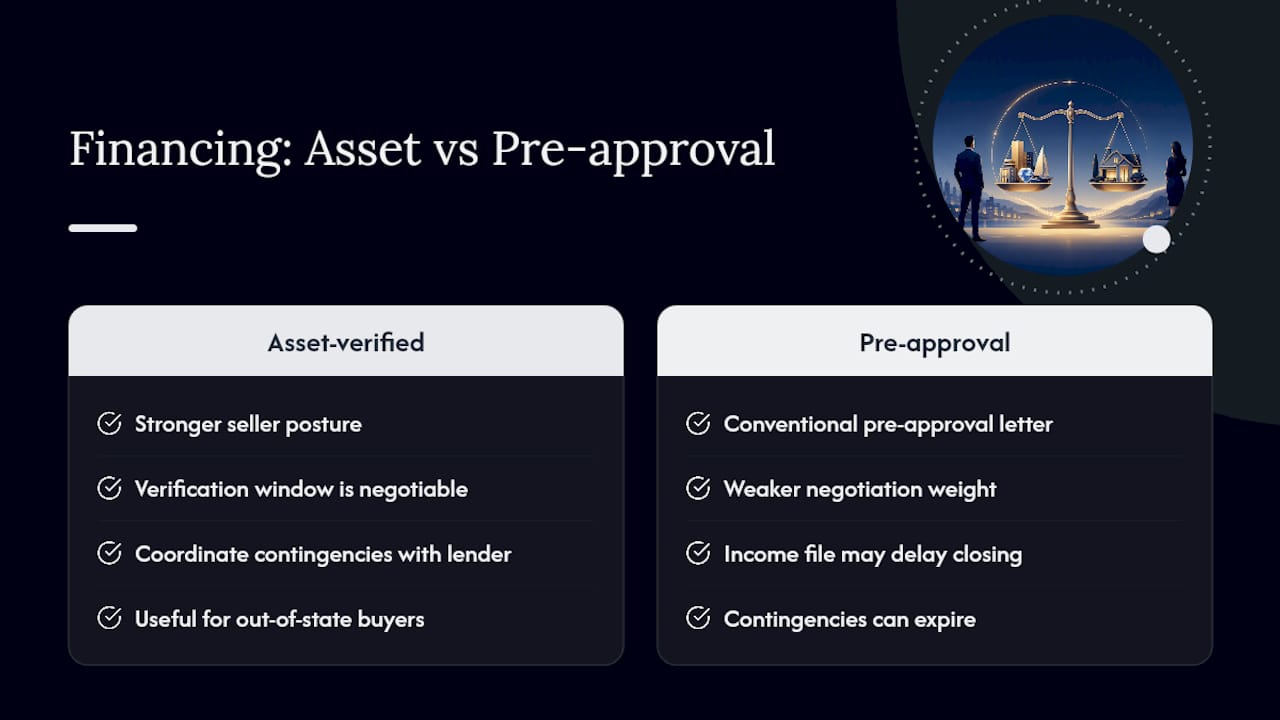
The mortgage math matters, but timing it against a competitive luxury purchase is where deals are actually won or lost. When a buyer's financing runs through asset verification rather than a straightforward income file, the verification window becomes part of the negotiation, not a background detail. An offer backed by pre-verified assets and a clear depletion calculation carries real weight with a seller's agent, often more than a conventional pre-approval letter does, because it signals the buyer's position is already settled.
That timing discipline matters even more for out-of-state buyers relocating into Las Vegas, where off-market opportunities move quickly and rarely wait for a financing file to catch up. Coordinating contingency deadlines against a lender's asset re-verification schedule, so funds stay untouched exactly when the lender needs to see them, is the kind of detail that keeps a deal from unraveling in its final week. Yhluxrealestate built its relocation concierge around exactly that friction point, pairing access to off-market inventory with the negotiation posture that comes from a buyer whose financing is already buttoned up. For readers weighing an asset-based purchase against the Las Vegas luxury market, Yhluxrealestate's buyer services are worth a direct conversation before you go house hunting.
— Yelena
This article is general information, not a substitute for advice from a qualified financial advisor. Consult a qualified financial professional about your own circumstances before acting on anything here.
Sources
- Employment Related Assets as Qualifying Income | Fannie Mae
- Asset Depletion Mortgage Guide 2026: How the Calculation Works | Defy Mortgage
- The Asset-Based Mortgage Master Guide 2026: Qualify on Assets, Not Income | LoanWise
- What is a debt-to-income ratio? | Consumer Financial Protection Bureau
FAQ
What Are Asset-Based Mortgages?
They're home loans that qualify borrowers using liquid assets, savings, brokerage, and retirement accounts, converted into an imputed monthly income figure instead of relying solely on pay stubs or tax returns.
What Is the $100,000 Loophole for Family Loans, and How Does It Work?
This refers to a federal tax provision allowing family members to lend money interest-free or below market rate up to certain thresholds without triggering imputed interest income rules; it's a tax and gifting strategy separate from asset-based mortgage qualification, and anyone considering it should consult a tax professional for current thresholds.
Do Most People Have Their House Paid Off When They Retire?
Not necessarily. Retirement plans vary widely, and many retirees still carry a mortgage balance, which is one reason asset-depletion programs exist: they let asset-rich retirees purchase or refinance without needing a traditional paycheck to prove repayment ability.